
Platform Security
Solutions
Resources
About Launch App Join Waitlist

Case study ยท Illustrative

1200 Harbor Tower

How the owners of a Las Vegas casino tower and its parking lot raised $85.6M for a renovation without selling, and how investors received their first rent payment.

Asset
Hotel-casino tower and parking lot
Location
Las Vegas, Nevada
Appraised value
$214.0M
Structure
Property SPV, leased to a licensed operator
Offered
40% of the SPV ($85.6M)
Holders
1,042 verified investors
Income
Monthly rent, paid in stablecoin
Owners kept
60% and full control

The starting point

A property worth keeping, and a renovation to fund.

The owners held a hotel-casino tower in Las Vegas and the surface parking lot beside it. The tower was leased to a licensed casino operator on a long-term lease, and the parking lot earned income of its own.

They wanted to renovate the tower's lower floors. Selling would mean giving up a property they meant to keep, and a bank loan would take months and come with terms set by the lender.

Why investors own the real estate, not the casino

The property and the casino are separate businesses.

Owning part of a gaming business can require approval from gaming regulators. So the tower and the parking lot sit in their own property company, an SPV, which leases the building to a separately licensed operator. Token holders own a share of the property and its rent; the operator runs the casino under its own license. Large REITs that own casino properties use the same split.
How it happened

From submission to first rent payment.

  1. Submission

    The owners submitted the property through List an asset and completed identity and business checks for the owning company.

  2. Certification by ACAN for Real Estate

    A title company searched the title and any liens, a title insurer committed to a policy, a certified inspector confirmed the tower and the lot exist as described, and an independent appraiser valued the property at $214.0M. ACAN verified each report, reviewed the casino lease and the parking income, and recorded it all. The certified record was anchored on-chain.

  3. A legal wrapper

    The tower and the parking lot were placed in a property SPV that holds title. The building never moved, and Arrabon never held it.

  4. Issuance

    A licensed issuer structured the offering under the applicable securities rules, including Regulation D for US accredited investors and Regulation S for investors outside the US, and issued tokens representing 40% of the SPV. The owners kept the other 60%.

  5. Listing

    The offering went live to verified investors on the ACAN marketplace. 1,042 investors took a position, and the owners raised $85.6M for the renovation without a sale or a bank loan.

  6. First rent payment

    At the end of the first month, the operator's rent and the parking income, after the property's costs, were paid out pro rata to every holder's settlement wallet in stablecoin. An investor holding 1,420 tokens received $442.

  7. Ongoing

    Title, insurance, the lease and the operator's standing are monitored, and the next payment is shown in advance. Where the offering allows, holders can list their tokens for sale on a compliant secondary venue.

In the investor app

The $442 payment, as the investor sees it.

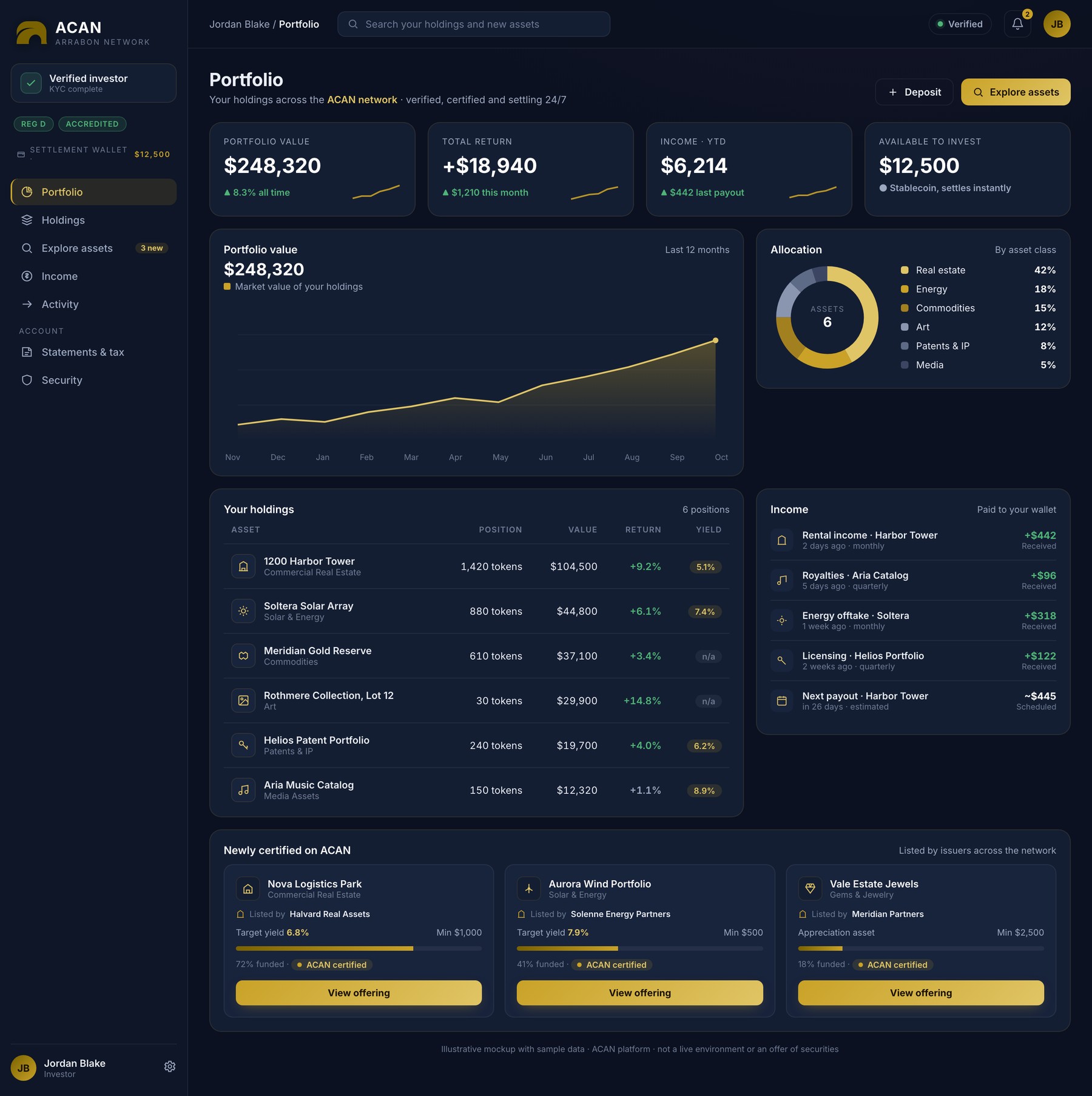
One holder's 1,420 tokens sit alongside the rest of their portfolio, with each rent payment landing in their wallet and the next one already scheduled.

The ACAN investor app showing a 1200 Harbor Tower position with a 5.1% yield and a $442 rental income payment.

1200 Harbor Tower in the investor app: the position, its 5.1% yield and the $442 first rent payment. Illustrative screens with sample data. Click or tap to enlarge.

The outcome

What each side got.

For the owners
  • Raised $85.6M for the renovation
  • Kept 60% of the property and full control
  • No sale and no bank loan
  • The lease and the operator stayed exactly as they were
For investors
  • A share of an income-producing Las Vegas property
  • Monthly rent paid straight to their wallet
  • One position to follow in the investor app
  • The option to sell where the offering allows

Honest about the limits

What it does not fix.

The operator still has to pay. If the casino has a bad year, rent can be cut or delayed, and so can distributions.

Property values move. The tower can be worth less tomorrow than today, and the tokens are not insured against that.

Selling depends on a buyer. Secondary trading is not guaranteed, so a holder may not be able to exit when they choose.

Gaming rules still apply. Changes in gaming regulation or in the operator's license can affect the property and its rent.

None of this is financial, legal or tax advice. See our full risks and disclosures.

List an asset

Own a property like this?

Tell us about it in a few minutes. Every asset goes through ACAN certification before it can be offered.